Digital Network ID: Social Programs
Showing posts with label Social Programs. Show all posts

22 Jun 2020

The High Cost of Good Intentions - Barokong

If indeed the Congress will now turn to entitlement reform, as house speaker Paul Ryan has promised, this will be the book to have on your desk. (Ryan already blurbed it (back cover) as did Bill Bradley, Sam Nunn, George Shultz and Alan Greenspan.)

If you think entitlement programs, and the political hash that enacts them, are recent problems, or the fault of one political party, think again. John's main lesson is that the emergence of bloated entitlements is a hardy feature of our (and many other countries') democracies.  He does this by just reading the history.

The habit of expanding entitlements started early. Chapter 2:

Revolutionary War pensions were the nation's first entitlement program. ... between 1789 and 1793, the federal government agreed to pay annual pensions to Continental Army soldiers and seamen who became disabled as a result of wartime injuries or illness. [later, as an inducement to service]...
For forty years, Congress enlarged and expnaded these benefits until, by the 1830s, they covered virtually all Revolutionary War seamen and soldiers, including volunteers and members of the state militia and their widows, regardless of disability or income.
That costs might balloon beyond forecasts was not a total surprise

Opponents of the 1818 law predicted that granting lifetime pensions to Revolutionary War veterans who were "in reduced circumstances" would be costly. Senator Nathaniel Macon of North Carolina observed, "Pensions in all countries begin on a small scale and are at first generally granted on proper consideration, an that they increase till at last they are granted as often on whim or caprice...[it] will on experiment, be found an endless task. It will drain any treasury, no matter how full."
Yet, the service pension law of 1818, which granted such pensions to all revolutionary war veterans who were "in reduced circumstances"

produced a massive surge in applications and an unexpected and unprecedented cost to the Treasury. The law's proponents had estimated that fewer than two thousand veterans would qualify and that the annual cost might reach $115,000. But by the end of 1819, more than twenty-eight thousand individuals had applied... The 1818 law's annual cost to the Treasury had ballooned from $300,000 to a staggering $1.8 million. ..widespread charges of pension fraud and corruption. A law designed to assist destitute veterans was providing pensions to many financially well-off veterans and even many who had never fought for the nation's independence.
...Congress's underestimate of the cost was on the first of many underestimates. These miscalculations are invariably due to Congress's failure to appreciate how an offer of entitlement assistance can cause individuals to change their circumstances to qualify for aid they have previously managed to live without.
This is a familiar theme in entitlement programs, but just how far back it goes was news to me.

A bigger theme of the book is the politics of entitlements. That also starts long ago. Congressman Dudley Marvin of New York reports

"In the villages in his part of the country, when the semi-annual pay day arrived, they [pensioners] were in the habit of forming themselves into companies, then forming a column and thus marching to receive their quota of the public bounty"
This spectacle served as an early hint of the sense of entitlement that can affect groups of recipients of public assistance... such groups can develop an expectation that society owes them benefits that initially were bestowed out of gratitude for military service or a desire to alleviate hardship. We will observe this expectation and the sometimes remarkable behavior it generates in later chapters on twentieth-century entitlements.
For example, a century later, the linkage between individual payroll taxes and benefits was crucial to the "enactment, long-run endurance, and, ultimately high cost" of Social Secrurity

Paying payroll taxes gave [gives!] program participants a sense that by contributing to the program during their working years, they were establishing an earned right to benefits when they retired. ... Senate Finance Committee chairman Walter George noted" Social security is not a handout; it is not a charity; it is not relief. It is an earned right based upon the contributions and earnings of the individual.
When [President Roosevelt] was challenged about financing Social Security with a regressive payroll tax rather than general fund revenues from the progressive income tax, he replied, "We put those pay roll contributions there so as to give the contributors a legal, moral, and political right to collect their pensions and their unemployment benefits. With those taxes in there, no damn politician can ever scrap my social security program. Those taxes aren't a matter of economics, they're straight politics"
Civil war pensions followed the same path, on a larger scale

The civil war pension program began with the same high-mihnded, noble, and limited goal as Revolutionary War pensons: to compensate soldiers for the loss of life and limb suffered in wartime service to their country... A half-century later the program evolved into a general disability and retirement program for virtually all Union soldiers...Congress also eventually stretched eligibility for pensions to virtually all widows and survivors of union soldiers, even those who had married many decades after the war had ended..
Costs ballooned, for example on the 1879 arrears law, that allowed soldiers to file disability claims after the original deadlines

The bill's senate floor manager, Sentaor John Ingalls, had put the total at $18 to $20 million. Hayes administration officials estimated a much higher cost of between $50 and $150 million. ... Two years after the law's passage President Chester A. Arthur reported that arrears payments had already cost taxpayers $235 million...It is fair to conclude that the law added nearly $400 million to pension expenditures during the 1880s alone
New interest and lobbying groups emerged

claims agents led the advocates for arrears payments. These agents, certified by the pensions office, assisted veterans and widows with the complex application process, represented claimants in appeals before the pension office, and received compensation for their services. ... claims' agents had emerged as a powerful lobbying force.
... The arrears act also spawned a second large national lobbying force: The Grand Army of the Republic (GAR). The GAR's evolution from a service organization ta special interest lobby..would be followed time and again by twentieth-centry lobby groups...
At this time, politicians discovered how important entitlements could be to electoral success, beginning the mad use of public money to buy votes that we see today.

The (1884) election campaign witnessed the use of the Pension office as a political machine to gain partisan advantage. (good story follows)
... Along with this legislation came an important and powerful discovery by the Congress and the executive branch: broadly distributing cash benefits directly to a large segment of the voting population could produce significant electoral advantages.
The story repeats again with WWI veterans.

There are occasional retrenchments and reforms, especially useful to ponder now.

Candidate Cleveland renewed his previous campaign promise to `cleanse the pension rolls and limit ... benefits to 'worthy' veterans. ...Voter backlash against the tariff and pension corruption contributed to President Cleveland's landslide victory.... Cleveland took immediate actions... The GAR rallied against this minor reform as if the pension rolls had been purged, decrying "false economy which shaves and pares to the quick at the expense of honor, justice and principle." ... by the time Preisdent Cleveland left office in 18997, there were 12,500 more Civil war pensioners than when he had taken office.
Interestingly, Franklin Roosevelt was a great enemy of large veteran benefits. Roosevelt

shared the founding fathers' belief that all citizens had an obligation to serve their country in wartime, and therefore did not represent a special class of individuals entitled to government benefits merely because they had served during wartime. .. His views were decidedly at odds with Congress, which invariably concluded that all wartime veterans, especially when they reached old age, stood as a special class.
Roosevelt also thought balanced budgets were important. He acted cleverly:

On Sunday night, the President gave the first of his legendary fireside chats, reassuring the public that the US banking system was in should shape. On Monday he sent to Congress his third message: to modify the Volstead Act to permit the sale of beer... an extremely popular proposal. Now the Senate was in a bind. Under Senate rules, action on the Volstead act could not take place until the Economy act had been addressed...
and they passed it

The law repealed all entitlements to pensions that had been granted to veterans of World War I, the Spanish American War, the Boxer Rebellion and the Philippine insurrection.. For the first [last?] time in US history, a large-scale entitlement had been repealed. ...
Several factors account for President Roosevelt's remarkable success in reducing veteran's pensions. The economy and federal budget's dire situation presented the president with a national emergency, and in Washington such emergencies are a strong predicate for action.. President Roosevelt was also willing to use his veto power to sustain his policies...
Roosevelt's attitude to veterans did not last.

*****

I'm up to the beginning, really, of the book, "The birth of the modern entitlement state." The centerpiece of the book is not these historical antecedents, but the political story of how the current US entitlements system evolved.

That story starts with the New Deal. It also brings in the judiciary, the "role of the federal courts in making public policy:"

The new Deal entitlements ushered in a new era for the federal courts. ... once federal entitlement rights had been granted, the nature and extent of these legal right had to be adjudicated....In the 1960s and 1970s, the federal courts .. expanded[ed] the legal rights of entitlement claimants in welfare, health care, and nutrition. Ultimately federal court decisions created welfare entitlement right where none had been legislated.
There are many more themes worth stressing, even in the ancient history, and I won't prolong the quotes delicious as they are.

One theme: Our government routinely liberalizes entitlements when budget surpluses are strong, and at least slows down their expansion in bad fiscal times. It also liberalizes entitlements in bad economic times.

That bears centrally on the current reform question.  Our entitlements are, no surprise, on an unsustainable path. We will either reform them, in a way that reduces federal spending, or we will substantially raise taxes on the "middle class," including a large payroll tax increase and likely a european style VAT on top of growth-killing income and corporate taxes.

If one wishes for a reform on the expenditure side, the great question is whether it must be done directly or via "starving the beast" of tax revenue. For example, I advocate a VAT. A common complaint is that the VAT is not only a much more economically efficient way of raising a given revenue, it is a great way to raise much more revenue, and my critics complain it soon will do that and provoke even greater spending. The VAT shifts the top of the Laffer curve to the right, and in my critics' view, the US government will operate at the top of the long-run Laffer curve given structural limitations on its tax code.

I have held out hope that our democracy could contain itself to spend less than the top of the Laffer curve allows, so we can jettison the insane inefficiency and corruption of our tax code, and have one that is vastly more economically efficient. The opposite view really amounts to belief that democracy is fatally flawed. Moreover, I note that starve the beast tax reductions have led to massive deficit expansions, yet large debt and deficits have not yet seemed to provide much pressure against entitlement spending.

John's history is a strong push toward starve the beast, at least in the negative direction. Surpluses lead to benefit expansions, quickly.

Another theme: The accounting gimmicks such as "trust funds." Surpluses in trust funds lead to benefit expansions, even if there are huge deficits outside. And "trust fund" accounting gimmicks also go back a long way.

As we (hopefully) start to think about reform, I think the only hope is to break out of "we're spending too much there will be a debt crisis" vs. "you heartless evil person, just look at (deserving person). How can you throw her off the bus." The way to do that, I think, is to focus on the disincentives of our social programs, not on the cost or the worthiness of recipients. I find some comfort in John's history, that occasional retrenchments, including the above and the welfare reforms of the 1990s got through politically by looking at fraud (a form of disincentive) and other disincentives.

This is a history and a political history, not a reform proposal, nor an economic analysis of disincentives. Still, John's history is also full of quotes reflecting the centuries old tension in welfare programs between helping those in need and disincentives, which I'll cover in the next post. That history ought to help.

A note for graduate students: This book is very well written, and you should read it to emulate writing style as well as for the subject. No, it does not knock you over the head with beautiful sentences as John McPhee might. It is, however, beautifully structured. The whole book and each chapter starts with a complete summary of the argument, and the chapter fills it out. It could go on for thousands of pages, but manages to tell just enough of the story so you see the historical detail, but not enough so you get lost in what must been have fascinating historical detail. Yet this is not a standard quickie book aimed at a policy controversy. This is a deep piece of scholarship. Everything is footnoted -- 78 pages of footnotes and reference all together.
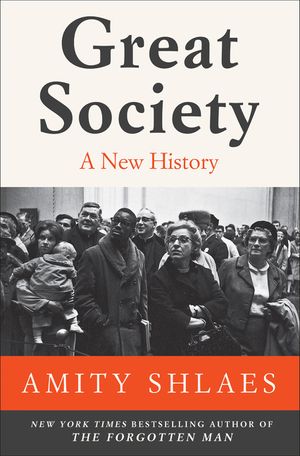
5 Jun 2020

Great Society Review - Barokong

The US is debating a fourth great wave of US government expansion. Theodore Roosevelt to Wilson the original progressive era and WWI; Frankin Roosevelt's new deal; and the Kennedy-Johnson-Nixon "great society" of this book came before us.

Plus ça change, plus c'est la même chose, is in many ways the theme of the book. The Great Society offers lots of parallels to our time, and a cautionary tale that it will all end badly once again. But not all is the same, and the many ways our time is different from the 1960s is also good to ponder -- for better and for worse.

Amity is a gifted writer and storyteller. Pay attention to her books also for how they are written. How do you tell the story of an era in a way that is comprehensible and memorable? Amity picks a few central (and now often overlooked) people, a few programs, and a few benchmarks (the Dow, the price of gold), and tells the story of the era through their eyes. It's the Game of Thrones approach to the Great Society.  Do not expect even a comprehensive list of all great society programs, diff in diff regression discontinuity estimates of their causal effects, or even charts and graphs (all curiously packed in an appendix and never referred to in the text) or the customary eyeball-glazing recitations of statistics. This was her approach to the Great Depression in Forgotten Man, equally effective. It complements, but does not substitute for that more structural work.

Introduction

In case you don't get the point, Amity starts right off in the introduction with Michael Harrington who wrote "a then-famous bestseller called The Other America" and who worked for Sargent Shriver, which is one of the main characters of the book (Daenerys Targaryen?)

Why not socialism? The president had been in office three months, and he wanted new ideas to distinguish himself from his predecessor. Could the author bring up socialism at the lunch? The very word “socialism” had been toxic until recently. ... The taboo was weakening, though.
..“socialism” might sound too controversial for the White House. The writer could, however, pitch ideas that took the country toward socialism. ... Laws that backed up organized labor so it might represent a greater portion of the American workforce... Higher minimum wages... Minimum wages that covered more workers, even those who did not work in an office or full-time. A dramatic change in the training of bigoted policemen in the big cities. ... The money was simply in the wrong hands. ... a tax system that captured the elusive wealth of the superrich. The moment had come to level incomes in a systematic fashion.
..The story sounds like something that could happen today."
The 1960s and early 1970s included a huge expansion of programs. And the results were in the end mostly abject failure.

Today

progressive proposals that bear a strong resemblance to Michael Harrington’s, from redistribution via taxation to student debt relief to a universal guaranteed income, are becoming popular again. Once again, many Americans rate socialism as the generous philosophy. But the results of our socialism were not generous. May this book serve as a cautionary tale of lovable people who, despite themselves, hurt those they loved. Nothing is new. It is just forgotten.
It is also a refreshing reminder of just how old most of the "new" ideas we are being bombarded from on the left are -- and a warning of how long they will pester us, at least as long as we are unwilling to learn.

From an SDS (students for democratic society) manifesto:

"The wealthiest 1 percent of Americans own more than 80 percent of all personal shares of stock"
The capsule stories of the 1960s focus on the civil rights triumph, the remaining politically successul programs such as medicare and medicaid, the vietnam war, and a vague hippy nostalgia. Shales' story, and the central roles of the forgotten (largely)  men she tracks are a novel tonic.

Stories

Walter Reuther, head of United Auto Workers, is a central figure, and the fight between the old-left unions and the new-left students epitomized by Tom Hayden, for the soul of the Democratic party.

Sargent Shriver, and the Office of Economic Opportunity are the stand-in for many ill fated programs. It starts with the predictable story of chaos that results from a flood of federal money.   The flood of federal money  did not stop the cities from burning.  The OEO is the beginning of Federal support for "community action" programs, including political activity.

"Community action programs, the authors [of the Community Action Program Workbook—262 pages on how to apply for and run a federally funded program] wrote, should provide the “stimulation of change.” One marker of a successful community action group was that it “increased competence in protest activities.” The OEO ... welcomed experiments, including those where community action organizers paid by Washington were “facilitating the opportunities for the poor to participate in protest actions.”
That kind of language was enough to send mayors like Dick Daley through the roof.
In the end, the cities went up in flames. The OEO morphed in many ways. One interesting almost afterthought of the original program, legal aid to the poor -- who can obect to that, helping poor people who can't afford lawyers? -- ballooned the way all such programs do,

"the governor [Reagan] was after the lawyers again, assailing California Rural Legal Assistance. The nonprofit should have stuck to individual legal aid cases for rural indigents, Reagan said, but instead had “converted itself into a vehicle for class action lawsuits against various government agencies.” Reagan told the crowd that his staff had reckoned that if the CRLA won all its suits in California, the cost of welfare there would increase by $1 billion—the same amount Johnson and Shriver had first set as the budget for the entire War on Poverty."
Here was where the government started paying lawyers to sue the government for more government.

Amity tracks disastrous housing policies through the life of the Pruitt-Igoe housing project in St. Louis, begun in earnest but remote social-planner hope, though destroying the community where it sat, and ending in controlled demolition.

"In some cases, only welfare families were entitled to the lowest rents at Pruitt-Igoe. And to receive welfare under Missouri’s rules, a family could have only one parent—the mother. So families considering life in the towers had to make a terrible choice: stay together or take the apartment. ..Families who moved into Pruitt-Igoe often lost a father. ...The social workers even policed apartments at night, checking to see if fathers had secretly returned, grounds for eviction. "
The consequences of which are predictable.

"Pruitt-Igoe elevators, which stopped only every few floors, were muggers’ traps. Poor maintenance meant the elevators often jammed, leaving gangs’ victims in with them for long extra minutes. The gangs lurked in the halls and made tenants “run the gantlet” to get to their doors. Young men threw bricks and rocks at windows and streetlamps; the activity was a regular sport..... Because there were no toilets on the ground floor, children had accidents there and in the elevators, and the elevators gradually became public toilets. The community area was a sorry joke... No one seemed able to stop the decay. "
I love this:

"Social scientists were descending on the complex to conduct multiyear investigations, and that irritated the tenants further."
we've been at it a long time, missing the ends of our noses.

"At Pruitt-Igoe, rents were scaled to income. Every time the Straughters’ wages went up, their rent went up, a tax on striving"
Income-capped rent subsidies are with us today.

"After tens of millions and decades of urban renewal spending, Detroit did not look renewed. Detroit looked, Mayor Cavanagh said, like a city that now did need a Marshall Plan, like “Berlin in 1945.” Almost three thousand businesses had been sacked, with damage many times greater than in Watts just two years before. "
In the end

"There was hypocrisy [and I would say a great deal of paternalistic disdain] in the  different treatment of the middle class and poor. For the middle class, the government had aimed to re-create and sustain the world of Alexis de Tocqueville, subsidizing home purchasers for suburban settlers. For the poor, however, the government had operated in the world of Karl Marx: government-sponsored housing blocks with tenants, not owners. Black citizens—Pruitt-Igoe was now all black—had been ripped from their roots when they moved North, uprooted again when they were moved for urban renewal, and then placed in high-rise rentals where putting down new roots was impossible."
"How might neighborhoods like this one have turned out if local companies, local authorities, and local individuals had led in the 1950s and 1960s, building their own Great Society? How might St. Louis have looked if the jobs had stayed? No one knew.  But here in the shadow of
Pruitt-Igoe, Father Shocklee and Pruitt-Igoe tenants had discovered one possibility. With his small housing program, Father Shocklee had shown that “the poor” were more like the middle class than people supposed. They gained from something only when they had a chance to own it."

Daniel Patrick Moynihan is a second central character in Amity's story (Tyrion Lannister?) Moynihan was a Democrat, but wrote the important and controversial "The Negro Family: The Case For National Action," pointing out, among many other things, the perverse incentives of welfare.

"From his work at Harvard and in Washington, Moynihan thought he had learned what was wrong with American welfare. The first trouble was that poverty funding tended to flow to bureaucrats—social workers, not poor people. “Feeding the horses to feed the sparrows,” Moynihan called it.  In many states, those social workers spent their time in perverse endeavors: inspecting apartments at Pruitt-Igoe to make sure no fathers were present, for example. Taxes hit people when they entered the workforce, reducing the appeal of working just as Eartha Kitt said. ...In some states, for example, a welfare mother working at the same job as a family father not on welfare took in 50 percent more than the man, because she was entitled to keep a portion of her welfare. Why not bypass the bureaucrats and send the money to families, regardless of whether fathers were present?"
And then he took a job with Nixon, and became one of Nixon's main advisers. He nearly got passed a negative income tax, the equivalent of today's universal basic income. In his grudgingNew York Times review, Binyamin Applebaum finds this story "curious," because it did not pass in the end. But it nearly did, which makes it important. Amity covers well the failed attempt to over rule right to work laws, which also nearly passed. Near failures good and bad are equally instructive to our current situation, no matter the flap of butterfly wings that determines their fate.  (The quick review of the UK's longer experience starting p. 335 is well worth it too.)

I found this amusing

"The crowd at Harvard had held even Hubert Humphrey, and at times Robert Kennedy, in contempt. Any interest in Nixon Harvard rated worse than reprehensible
The schoolmates of Moynihan’s children stopped talking to them. Alan Rabinowitz, a fellow academic, wrote a satirical poem chiding Moynihan for his betrayal, “The Knight Before Nixon.”
Plus ça change in academia, and much Trump-deranged society.

Fairchild semiconductor plays a small but significant role. It's good to remember how different the US economy of the 1950s was. There really were a few very large companies in most industries, and most technology came out of defense. The emergence of an innovative private tech sector is one of those many ways we are not replaying exactly the same song. The slow emergence of Toyota and VW, selling better cars and forcing change in Detroit is another.

Money and gold

A minor story for the book caught my eye, and I pass it on first as many blog readers are interested in monetary issues. One of the themes of the book --  the snow level on the great white wall -- is the price of gold, and the US continuing problems of gold outflow, the emergence of inflation, and the eventual collapse of the Bretton Woods system. This is an event much too little studied by macroeconomists, though my international and economic history friends tell me that shows just how parochial we are and we should start reading their papers.

In macroeconomics perhaps we are too influenced by Milton Friedman's great called home run, the 1968 presidential address, where he forecast inflation would emerge along with unemployment. But Friedman's story was told entirely in terms of the money supply and to a lesser extent interest rate targets, the one too large and the other too low. And that is how the stylized history has come down to us: Fiscal deficits from the Great Society and Vietnam war, combined with too loose monetary policy, set off inflation.

That story leads to the puzzle of our age: If the (by current standards) comparatively minor Johnson-Nixon deficits set off a grand inflation why do our huge deficits have no such effect now, despite many officials stated desire for more inflation?

The story of the book reminds us that the mechanics were quite different then, and leads me to the speculative thought that the gold standard mechanism brought on inflation much more quickly than our current arrangements. In part, it may have been designed to do so -- to force governments to make fiscal adjustments quickly rather than let the problem get so big the fiscal adjustment will be immense, much as Doug Diamond and Raghu Rajan model short term debt and its runs as a disciplining device to managers.

The world was different then. We had fixed exchange rates, and it was difficult to move capital from country to country -- to buy foreign stocks, for example. Bretton Woods was not really set up to handle today's large trade deficits financed by large capital account surpluses. When the US started running trade deficits, other countries piled up dollars, and the main thing they could do with those dollars was to turn them in to their central banks, who in turn used them to drain gold from the Fed. So, it strikes me that open capital markets that allow us to finance large trade deficits are an important reason our system has held up so long.

Amity tells the sad tale of stopgap measures -- bans on using dollars for foreign travel, half-hearted interest rate increases, looney schemes for the Federal Government to mine gold, and of course the tragedy of price controls.

In any case, the remaining gold standard between central banks, not very open capital markets, not very open currency markets and fixed exchange rates were a crucial part of the inflation dynamics in this period, not just bad money supply or interest rate rules.

The episode also raises the counterfactual question why the US did not use the many devices used to defend the gold standard through the centuries. Borrow gold. Temporarily suspend convertibility.

Coda

At the end of a review that had to be negative, though he had to admit the quality of the book,New York Times review, Binyamin Applebaum writes

"Half a century later, in the midst of a revival of interest in ideas like Moynihan’s basic income proposal, readers may find themselves wondering whether the nation’s problem is really too much government — or, perhaps, not enough."
One wonders just what it would take to ever change his mind on that one. Were the 60s riots, the 70s economy, and the evident pathologies of the welfare system not bad enough, or do we have to go full Venezuela first? After all these years, and with the same policies on agenda, with the same predictable disincentives and unintended consequences, could not his call be at least for smarter government, not just more? For a larger government that learns from rather than repeats this sad history?

30 May 2020

The Elephant's family - Barokong

David Brooks essayin the Atlantic "The nuclear family was a mistake" has a lot of interesting ideas. We used to (1800s) largely live with extended family. In the mid 20th century we moved to mom, dad and kids, the nuclear family that David thinks is a mistake. Now we increasingly live the widely parodied Life of Julia (Taranto scathing review at WSJ, guide to parodies at Atlantic), individuals whose main relationship in life is to the federal government.

One aspect, tangential to the main theme, struck me. In all our economic discussions about inequality, when we stop shouting at each other, we come down to a commonsense middle ground: There are lots of obstacles in the way of economic, personal, and social advancement for Americans who start on the lower end of the economic ladder. Free marketers tend to point to government obstacles -- horrible schools in the thrall of teacher unions, land use policies that make it impossible to live near better jobs, social programs whose disincentives to work or move to work make that an impossible choice, and so on. Government-run-things advocates ask for more programs, a 58th job training program, UBI, government jobs, government provided housing, more money to the teachers unions, government-run pre-k and day care, gushers of money, and so on. Still, we get to a comfortable point that we agree on a problem, and we're talking about various ways to fix it.

Into this comfortable discussion, Brooks' essay points to the elephant in the middle of the room.  People on the lower economic end in this country start their lives in chaotic families.

In 1970, the family structures of the rich and poor did not differ that greatly. Now there is a chasm between them. As of 2005, 85 percent of children born to upper-middle-class families were living with both biological parents when the mom was 40. Among working-class families, only 30 percent were. According to a 2012 report from the National Center for Health Statistics, college-educated women ages 22 to 44 have a 78 percent chance of having their first marriage last at least 20 years. Women in the same age range with a high-school degree or less have only about a 40 percent chance. Among Americans ages 18 to 55, only 26 percent of the poor and 39 percent of the working class are currently married.
In 1960, roughly 5 percent of children were born to unmarried women. Now about 40 percent are. The Pew Research Center reported that 11 percent of children lived apart from their father in 1960. In 2010, 27 percent did. Now, if you are born into poverty and raised by your married parents, you have an 80 percent chance of climbing out of it. If you are born into poverty and raised by an unmarried mother, you have a 50 percent chance of remaining stuck.
Nothing, nothing, in our pleasant dirigiste anti-inequality debate adds up to these kinds of numbers. A year of government run pre-K while not even talking about these facts is like handing out bandaids to cancer patients.

Brooks goes on to a later stage in life, the difficult transition to adulthood.

Extended families provided men with the fortifying influences of male bonding and female companionship. Today many American males spend the first 20 years of their life without a father and the next 15 without a spouse. Kay Hymowitz of the Manhattan Institute has spent a good chunk of her career examining the wreckage caused by the decline of the American family, and cites evidence showing that, in the absence of the connection and meaning that family provides, unmarried men are less healthy—alcohol and drug abuse are common—earn less, and die sooner than married men.
This is not a new insight, really. It's just the great unmentionable. When in any inequality discussion did anyone point to the fact that hordes of children are growing up in chaotic family lives as the central problem, and the central thing that has gotten worse in the last decades? When in any job training discussion do we point out that young men growing up alone learn from their gang? Even elephants need families to grow up, and young elephants raised alone are ill-behaved and unmoored.

It is the great unmentionable:

Highly educated progressives may talk a tolerant game on family structure when speaking about society at large, but they have extremely strict expectations for their own families. When Wilcox asked his University of Virginia students if they thought having a child out of wedlock was wrong, 62 percent said it was not wrong. When he asked the students how their own parents would feel if they themselves had a child out of wedlock, 97 percent said their parents would “freak out.”
But if we do not mention it, we're wasting our time.

A central question for all of us is the disincentives that government programs have had for families. As I see it, the life-of-Julia experiment has this disincentive. It's not a new or partisan view -- Daniel Patrick Moynihan started in the 1960s pointing out that giving welfare conditioned on no men being present was a huge mistake.

Brooks goes quickly to culture.  But culture also responds to incentives.

We are indeed not homo economicus, either individuals facing a market or individuals facing the array of government programs. Especially as we grow and mature, we are a social animal, homo of the family, of the extended family, of the village. Now absent.

****

Response to Jeremy:

This is an excellent point, other than the snarky tone ("convenient"). I did not claim an exclusive list, just a starting point. The war on drugs, and the disastrous effects of the criminal justice system on many lives is surely a contributor. Here's a place I'm for a lot more government spending. Efficient law and courts are infrastructure too. In order to catch criminals, we do not need to ruin this many lives of innocent people. And we could do a darn better job of catching criminals too -- crime rates in low-income neighborhoods are shocking, destroying business, opportunities, incentives and lives.

English

Anies Baswedan

Tekno