Digital Network ID: Debt
Showing posts with label Debt. Show all posts

21 Aug 2020

Kotlikoff on the Big Con - Barokong

In preparing some talks on the financial crisis, 10 years later, I ran across a very nice article,The Big Con -- Reassessing the "Great" Recession and its "Fix" by Larry Kotlikoff. (Here, if the first link doesn't work.)

Larry is also the author ofJimmy Stewart is Dead – Ending the World's Ongoing Financial Plague with Limited Purpose Banking, from 2010, which along with Anat Admati and Martin Hellwig'sThe Bankers' New Clothes is one of the central works outlining the possibility of equity-financed banking and narrow deposit-taking, and how it could end financial crises forever at essentially no cost.

Larry points out that the crisis was, centrally a run. He calls it a "multiple equilibrium."  Financial institutions have promised people they can have their money back in full, at any time, but they have invested that money in illiquid and risky assets. When people all do that at the same time, the system fails. Such a run is inherently unpredictable. If you know it's happening tomorrow, you run to get your money out and it happens today.

This is a common view echoed by many others, including Ben Bernanke. What's distinctive about Larry's essay is that he pursues the logical conclusion of this view. If the crisis was, centrally, a run, all the other things that are alluded to as causes of the crisis are not really central.  Short-term debt, run-prone liabilities are gas in the basement. Just what causes the spark, how big the firehouse is, are not central, as without gas in the basement the spark would not cause a fire.

Larry puts it all together nicely by starting with the 2011 Financial Crisis Inquiry Commission report:

"There was an explosion in risky subprime lending and securitization, an unsustainable rise in housing prices, widespread reports of egregious and predatory lending practices, dramatic increases in household mortgage debt, and exponential growth in financial firms’ trading activities, unregulated derivatives, and short-term “repo” lending markets, among many other red flags. Yet there was pervasive permissiveness; little meaningful action was taken to quell the threats in a timely manner. "
Larry then takes apart each of these non-culprits, as below.

In my view, the understanding that the crisis was a run, that without a run there would have been no crisis, somewhat like the 2000 tech stock bust, and that lots and lots more capital is the only real answer, has emerged slowly over the last 10 years. Larry's essay is good for putting all the others to rest.

The insight is also optimistic. It is possible to fix one clear simple thing -- too much short-term debt, not enough capital. If all the long list of vague maladies named by the crisis commission need to be fixed by super-powerful and financially clairvoyant regulators, the job is hopeless despite the immense government expansion that would entail.

In many of these items, I think Larry oversteps a bit. The argument only needs to be that "these things might have been problems, indeed, they might have caused a recession, but without a run, induced by short-term debt, there would have been no financial crisis." Larry goes on to cast doubt whether any of them are problems at all, which is fun and provocative but more than necessary. Moreover, Larry really goes on to view recessions themselves as multiple equilibria, which is an interesting and provocative idea, but not necessary.

Larry's essay is even more to the point today. I'm at theFinancial Cycles and Regulation conference at the Bundesbank. Every paper so far takes it for granted that there is such a thing as a "financial cycle," a buildup of "excessive" or "imbalanced" debt that precedes an inevitable round of default and crisis. It is the regulator's job to manage such "debt cycles" actively. Larry's essay disagrees from the word go. It's nice to have two diametrically opposed ideas in mind.

Larry's List follows. If you get bored, skim to the bottom for his more provocative ideas on runs.

1) Liar Loans, No Doc Loans, NINJA Loans and Other Subprime Mortgages

There just weren't that many subprime defaults, especially before the crisis hit. (And, I would add, defaults not insured by fannie, freddie, etc.)

2) The “Unsustainable” Rise in Housing Prices

House prices have risen and fallen before. And, I might add, many are sustained. If you're waiting for houses in Palo Alto or Manhattan to fall to, say Joliet IL levels, you may have a long wait ahead of you.

Larry makes an interesting comparison of real house prices with real GDP,

.. real house prices can rise for years, indeed, decades. They did so essentially every year for the 32 years between Q1 1975 and Q1 2007. The rise was both smooth and gradual with real house prices only 64 percent higher in Q1 2007 than they were in Q1 1975 – this despite real GDP rising by 170 percent over the same interval.

The comparison between real house price and real GDP is unusual. Larry writes

In any case, it's not a financial crisis without short-term debt.

Certainly, a temporary drop in house prices could have produced a contraction in construction.... Moreover, a decline in a given sector doesn’t augur an economy- wide recession.

And, an important point

a drop in the price of homes does not adversely impact most homeowners. Yes, the value of their asset falls. ...

But you still get to live in the house. If you could pay the mortgage before, you still can.

if we’re talking about a nationwide decline in house prices, as we are with the GR, even those who moved experienced no economic harm because their ability to buy at a lower price offset their need to sell at a lower price.

The house price drop was great news for young people who live in apartments, as the stock price drop was great news for their retirement investment opportunities. Yes, there are theories in which the losers impact the economy asymmetrically, such as Mian and Sufi's, but we're straying away from the point here. A house price "bubble" and "burst" is not per se a reason for a financial crisis.

As in many of these "causes" it's important to distinguish events before October 2008 from those afterwards. Yes, there was a huge recession, and that caused house price declines, job losses, mortgage defaults, and so forth. But causes of the crisis have to come first.

3) Ratings Shopping

"overrating affected less than one half of one percent of the U.S. bond market. Furthermore, this small figure surely overstates the importance of ratings shopping as many of the downgrades were caused by the GR itself,"

4) Increased Bank Leverage

"Sky-high bank leverage is another part of the standard GR explanation....Bank leverage actually fell over the period 1988 through 2008.16 Equity rose from 6 percent of bank assets in Q1 1988 to 10 percent in Q1 2008."

Be careful here. Larry's point is that there was no voluntaryincreasein leverage, and especially as measured and monitored by regulators, and no such increase was a key cause of the crisis.  That doesn't mean the overall amount of leverage is fine. Larry's main point, as mine, is that the banking system has way too much leverage overall.

5) Too Little [Regulatory] Capital

"According to Cox [ Christopher Cox, Chairman of the U.S. Securities and Exchange Commission (SEC)..], Bear Stearns was well capitalized when it failed, with a capital ratio over 13 percent and a debt-equity ratio of 6 to 1. Indeed, it appears that Bear Stearns could have easily passed the current Dodd-Frank stress test immediately prior to its demise. Consider this statement from Chairman Cox.
"The fate of Bear Stearns was the result of a lack of confidence, not a lack of capital. When the tumult began last week, and at all times until its agreement to be acquired by JP Morgan Chase during the weekend, the firm had a capital cushion well above what is required to meet supervisory standards calculated using the Basel II standard. "
Lehman was also well capitalized prior to its demise. It had tier-1 capital of 11 percent when its creditors pulled the plug. An 11 percent capital ratio is close to the current banking system’s tier-1 capital ratio of 12.3 percent, calculated based on the Federal Reserve’s recent stress tests. This indicates that today’s banking system is no safer than was Lehman Brothers when it was driven out of business."

Again, in this draft, Larry doesn't emphasize enough that the point is adecline in capital, aweakeningof regulations, or a decline in regulatory capital. His and my overall point is that capital needs to be much, much larger overall, and that will stop runs. But the event of the crisis was a combustion of the regular old gas in the basement, not an addition of lots of new gas.

6) Egregious and Predatory Lending

i.e.

"adjustable-rate mortgages, mortgages with balloon payments, interest-only mortgages, piggy-back, and so-called pay-option ARM loans."

of these,

"...in 2007, before the GR, the foreclosure rate was 5 percent. Its lowest value, between 2002 and 2007, was 3 percent, which was observed in Q3 2005.If one assumes that all of the 2 percentage-point increase in subprimes involved predatory lending, we’re still talking about predatory lending causing, at most, 0.3 percent more mortgages to definitely default, namely, enter foreclosure. This is simply too small a figure to matter to the overall economy. Indeed, given the size of the 2007 mortgage market, it represents just $32 billion. In 2007, U.S. GDP was $14.4 trillion. The economy’s 2007 total net wealth was $68 trillion."

The Dodd-Frank act piled every suggested fix to every perceived financial problem in one place. Even if one regards predatory lending as a problem, even if one does not regard competition as the best disinfectant and guarantor of good treatment, even if one thinks it needs fixing, Larry's point is that such a fix has nothing to do with stopping crises.

7) Dramatic Increases in Household Mortgage Debt

Surely, the addition of over $750 billion in mortgage debt in the course of 6 short years must represent a priori evidence that a massive recession was in the works. Not so. ... The increase in borrowing to purchase homes was not associated with a massive spending spree on the part of the American public. Indeed, the share of GDP consumed by the public remained fixed at roughly 67 percent between early 2002 and late 2007.

What about household debt payment service as a share of disposable personal income? There was an increase prior to the GR, but nothing extraordinary. Between Q4 2001 and Q4 2007, the ratio troughed at 12.1 percent in Q2 2004 and peaked in Q4 2007 at 13.2 percent. A 13.2 percent ratio is small and the increase from trough to peak is only 9 percent

As with houses, your debt is my asset. Larry is verging here into causes of the recession rather than the crisis. There is a case for asymmetries, but the first-order mistake is to think that just because I am in debt we all are in debt.

8) Exponential Growth in Trading Activity by Financial Firms

Here, again, we have a supposed reason for the Great Recession that has no counterpart in economic theory. If Joe and Sally sell the same share of stock back and forth to each other an infinite number of times in, say, a second, nothing real will happen to Joe and Sally or the economy.

9) Unregulated Derivatives and the Repo Market

The reigning narrative – that derivatives were misunderstood and over rated by compliant rating companies – has been questioned in a recent study by economists Juan Ospinal and Harald Uhlig. They examined 8,615 residential mortgage-backed securities (RMBS) over the period 2007-2013, almost all of which were rated AAA. Through 2013, the cumulative loss on these “toxic” securities was only 2.3 percent. Some three quarters of the AAA-rated RMBS had essentially zero losses through 2013. On a principal-weighted basis, the average loss rate was only 0.42 percent.

I think the logic here is that if securities were overpriced, then they should have fallen. That they did not is interesting. Of course, if they had fallen that is not necessarily evidence of overpricing, as there was a huge recession after the run!

Here again I think a big qualification is in order. The run on repo was a central part of the crisis, and I think Larry and I agree that way too much such run-prone financing was the key cause of the crisis. Again, I think the point Larry is making is that the financial system as constructed is always vulnerable, that the crisis was not brought on by some sudden and preventable increase in debt.

10) Investors Mispriced/Ignored Risk

11) Unaligned CEO Incentives

Yet another explanation for the GR is that CEOs of financial institutions had too little “skin in the game.” Jimmy Cayne, former head of Bears Stern, would surely disagree. Cayne lost close to $1 billion as his bank collapsed. Ken Lewis, CEO of the Bank of America, had $190 million to lose by making wrong decisions and succeeded in losing $142 million. Lehman Brothers’ Dick Fuld received most of his 2007 compensation in the form of Lehman Brothers’ stock.

12) Democratization of Finance

Under this theory, government sponsored enterprises (Fanny and Freddie) and government regulators were too permissive with banks in their quest to help the poor get into affordable housing. ...if this were the chief or even a major cause of the GR, subprime mortgages would need to have played a much larger role than they did.

13) The Federal Reserve Kept Interest Rates Too Low

Thirty-year mortgage interest rates were certainly lower between 2000 and 2007 than in the prior quarter century. But they weren’t that low especially adjusted for inflation. In the 1990s, the real 30-year mortgage rate averaged 7.91 percent. It averaged 6.27 between January 2000 and December 2007. This decline is hardly something to write home about, let alone pretend is the underlying GR culprit.

Runs

..the foundational bank-run models --- Bryant (1980), Diamond-Dybvig (1983), Pech and Shell (2003) and related models – admit multiple equilibrium in which financial-market collapse arises absent any fundamental financial- or real-sector problem...  from the perspective of these models, the question is not whether the banking system will fail, but when. Hence, it’s passing strange that the FCIC report makes no mention whatsoever of either paper, let alone the theory underlying bank runs.

(My emphasis.) Larry goes on for several pages documenting spreading panic. An earlier quote is good here

SEC Chairman, Mary Schapiro’s, 2010 testimony to the House Financial Services Committee...includes this statement.
The immediate cause of Lehman's bankruptcy filing on September 15, 2008 stemmed from a loss of confidence in the firm's continued viability resulting from concerns regarding its significant holdings of illiquid assets and questions regarding the valuation of those assets. The loss of confidence resulted in counterparties and clearing entities demanding increasing amounts of collateral and margin, such that eventually Lehman was unable to obtain routine financing from certain of its lenders and counterparties

The banks failed because they could. And they could fail because they were leveraged. They falsely promised to make repayments regardless of the circumstances.

Unsafe at Any Speed, and the limits on bailouts

The overall level of leverage is way too high. This reinforces my earlier interpretation of Larry's comment about leverage not being the problem -- there was way too much leverage, but its increase did not directly cause a crisis.

The next part is really interesting.

The Federal Reserve is also leveraged. In the aftermath of Lehman’s collapse, the Fed effectively insured not just checking and saving accounts, but also money market funds. These obligations were officially and, respectively, FDIC and Treasury obligations. They ran to some $6 trillion. But neither institution had $6 trillion in ready cash to make good on its insurance. Hence, the Fed would have been on the hook. Indeed, had things gotten worse, there would surely have been a run on the life insurance industry’s cash-surrender value policies, which, at the time, also totaled roughly $6 trillion.
Now imagine, as discussed in Kotlikoff (2010), that the government’s explicit and implicit pledges of insurance had been called by the public. I.e., suppose the public had, despite the promises of government insurance, headed straight to the banks, money market funds, and insurance companies to empty out their accounts and cash out their cash-surrender value policies. In this case, the Fed would have had to print $12 trillion virtually overnight. The M1 money supply at the time was just $1.5 trillion. Hence, this would have produced fully-justified fears of hyperinflation leading everyone to run for their money before prices soared
The U.S. has yet to experience a run on its central bank. But this is common in countries like Argentina, ...

Larry is, of course, an expert on all the explicit and implicit credit guarantees our government offers. I was unaware that $6 trillion of "cash surrender value policies" existed, and given the bailouts of other insurance policies we would certainly have seen them bailed out too. Fannie and Freddie guarantee most mortgages.

Though it does represent promises of payment, I don't think this really is "leverage" of the Federal Reserve. The government has, in essence, written a lot of put options, which is a different thing.

What happens in an even more massive run, with more massive bailouts is an interesting question. It's not as simple as "print [ing] $12 trillion overnight." The Fed issues reserves, convertible to cash, but always in return for something else. So, this would have put a big strain on the Fed's legal limitations of what collateral it can accept and from who.

The Fed mostly deals with commercial banks. Imagine a massive run on commercial banks, perhaps stemming from a rumored cyberattack that emptied one of them out. The Fed would have to lend against the entire portfolio of bank assets, not just liquid securities. Goodbye Badgehot.

As Larry points out, really the FDIC and Treasury are the ones guaranteeing non-bank debts.  The Treasury would have to borrow $12 billion overnight, sell it to the Fed, and then use it to bail out here and there. The ban on direct Fed-Treasury purchases would make this very hard, and would probably have to be scrapped.

But the huge increase in money would clearly be a temporary increase in money demand, and not obviously inflationary. Moreover, the Treasury, Fed, FDIC, etc. would take on assets. If these operations could be reversed after the panic passes -- if there is not a tremendous amount of actual lost value, as there was not last time, the money could be soaked up again. Even if not, the operation would not be inflationary if people thought the government could retire the debt and soak up the interest-paying reserves by future surpluses. We get inflation -- and Argentina gets inflation -- if and only if this nightmare involves a large fiscal transfer, that the US government cannot or will not pay off, that is financed by a permanent increase in non-interest-paying money.

US Federal debt is about $10 trillion larger than in 2008, and we're running $1 trillion deficits, with no end in sight. The reliability of the fiscal resources to make good on all these put options is, I think, a serious problem, and the heart of the potential inflation Larry describes.

The Role of Opacity

Bear Stearns was among the first to be picked off by those who stood to gain by a financial collapse because it was viewed as particularly opaque
The fact that Bear’s stock was valued at $60 per share one week before JP Morgan bought it for $2 per share (less a $29 billion sale of Bear’s troubled assets to the Fed valued at far less than $29 billion) tells us that no one knew anything about Bear’s assets, either before it died or when it died. Its valuation was, it seems, purely a matter of conjecture. Before it didn’t, the market apparently though Bear’s assets were worth something because everyone else thought its assets were worth something. This too is the stuff of multiple equilibria

Gary Gorton likens financial crises to a salad bar, where someone says "there's a news report of e-coli in the (inaudible)". So what do you do? Absent information on which ingredient has the e-coli, and the time or inclination to investigate, you go order a hamburger.

Now ask yourself, where is there a mountain of debt that can't be repaid, much of it very short term, phoney-baloney accounting, and opaque off-balance-sheet exposures (put options)? Sovereigns.

Bottom line

The first conclusion seems to me spot on. The second one is more provocative. Here Larry signs up with multiple-equilibrium theories of recessions, as well as simple multiple equilibria associated with run-prone assets like overnight debt. It's verbally plausible. If you think there will be a recession tomorrow, you fire workers and do not invest, and there is a recession today. But you can see a crucial derivative needs to be greater than 1.0 for that to work. Lots of formal models have multiple equilibria, but I've spent 10 years putting nominal multiple equilibria back in the new-Keynesian model, and real multiple equilibria are harder to get going.

Choose your equity-financed banking flavor, and we can end financial crises forever. Just why we don't do it seems an important -- and sadly forgotten -- question.

30 Jun 2020

Volatility - Barokong

An essay at The Hill on what to make of market volatility:

What’s causing the big drop in the stock market, and the bout of enormous volatility we’re seeing at the end of the year?

The biggest worry is that this is The Beginning of The End — a recession is on its way, with a consequent big stock market rout. Is this early 2008 all over again, a signal of the big drop to come?

Maybe. But maybe not. Maybe it’s 2010, 2011, 2016, or the greatest of all, 1987. “The stock market forecast 9 of the last 5 recessions,” Paul Samuelson once said, and rightly. The stock market does fall in recessions, but it also corrects occasionally during expansions. Each of these drops was accompanied by similar bouts of volatility.  Each is likely a period in which people worried about a recession or crash to come, but in the end it did not come.
Still, is this at last the time? A few guideposts are handy.
There is no momentum in index returns. None. A few bad months, or days, of stock returns are exactly as likely to be continued as to be reversed. The fact is well established, and the reason is simple: If one could tell reliably that stocks would fall next month, we would all try to sell, and the market would fall instantly to that level.
Twenty percent volatility is normal. Twenty percent volatility on top of a 5 percent average return, means that every other year is likely to see a 15 percent drop.
Big market declines come with a recession, as in 2008. But recessions are almost as hard to forecast as stock prices, and for much the same reason.

...

They asked me to hold off a few weeks before posting the whole thing. So either wait two weeks or head over to The Hill. I also wrote here "The Jitters" related thoughts about the spring 2018 bout of volatility.

27 Jun 2020

Lend the shutdown? - Barokong

The Federal Government seems to be obeying with rather remarkable accuracy the constitutional mandate that the government may not spend money that has not been appropriated by Congress.

I would be curious to hear from legal experts, however, what stops the government from lending money to federal employees, or just guaranteeing loans.

After all the government lends money all over the place, and credit guarantees are even larger. Is the Treasury no longer operating small business loan programs? (Honest question.) Is the Fed no longer lending money to banks, if they want it? Are Fannie and Freddy refusing to buy home mortgages because the funds to guarantee home mortgages (which it does) are not appropriated? No. As far as I can tell, Federal lending and loan guarantee programs are up and running.

If so, what stops the Treasury, from either lending money directly to Federal employees, or guaranteeing private lending. After all, the Treasury will write their back paychecks when the time comes, so these are potentially risk free loans. What stops the Treasury from just writing on a federal employees' paycheck "this is a loan against your back pay?"

Or... Social security and Medicare are still running. Can they write advances against social security payments that will be deducted from future federal paychecks?

I presume there is something stopping this -- that it is a step too clever, like the trillion dollar coin solution to the debt limit. But I would be curious to hear what the limitation is.

(HTMarginal Revolution on federal employees' other sources of financing, at pretty high interest rates.)

13 Jun 2020

Why stop at 100? The case for perpetuities - Barokong

Issue 100-year Treasurys,advocates the Wall Street Journal.  It mentions a short notedeep on the Treasury website that

Treasury’s Office of Debt Management is conducting broad outreach to refresh its understanding of market appetite for a potential Treasury ultra-long bond (50- or 100-year bonds).
My 2 cents: Why stop at 100?Issue perpetuities!

(I wrotea whole paper on this a while ago, if you want lots of detail and answers to practical questions. Unfortunately the Treasury website does not say how to send in suggestions, and nobody outreached to me, so this blog post is it.)

Perpetuities are bonds with no principal payment. Each perpetuity pays $1 forever.  If interest rates are 3%, to borrow $100, the government would sell three perpetuities, and then pay investors $3 each year. When the government wants to pay back the debt, it simply buys back the perpetuities on the open market.

A 100 year bond is almost a perpetuity. If the government issues a $100 100 year bond at 3%, only 100/(1.03)^100 = $5.20 of that value comes from the $100 principal payment. 95% of the value of a 100 year bond is already in the stream of coupons. For the investor, they are practically the same security. In particular they have nearly the same sensitivity to interest rate changes.

But perpetuities are better. Most of all:Perpetuities would be much more liquid -- easy to buy, sell, and use as collateral.  The reason is simple. Once 100 year bonds get going, there would be 100 separate and distinct issues outstanding. The 2123 2.6% 100 year bond is a different bond from the 2124 2.7% 100 year bond. If a dealer has an order for the first and an offer for the second, he or she cannot make the trade. If you borrow and sell short the first, you cannot deliver the second in return. This segmentation would make the markets for each bond thinner, and the bid ask spread larger. It would keep a lot of dealers and traders and market makers needlessly in business, which may  be one good reason the financial industry seems largely against the idea.

Perpetuities, by contrast, are a single security. When the government borrows more next year, it is borrowing more of thesame security.  There is one, thick, transparent, low-spread market.

A more liquid market would pay lower rates.  Much of the point is for the government to borrow at low rates. Much of the reason government debt has such low interest rates is that it is very liquid -- easy to buy and sell, the "safe haven" in bad  times and so forth. Government debt is somewhat like money, and like money pays less interest in return for its liquidity. Well, then, the more liquid the better!

A 100 year bond would make sense if there were a group of investors sitting around who really wanted to have $3 coupons for 100 years, and then $100 exactly in 100 years, not 101 years, and they were not planning to buy or sell in the meantime. That is not remotely the case. Long term bonds are actively traded. Perpetuities match the varied investment horizons of ultimate investors, and by being more liquid are more flexible.

There is plenty of historical precedent. Perpetuities actually came before long-term bonds. They were the cornerstone of UK finance for the entire 19th century.

One can raise a bunch of practical objections, and if you have them go check out thepaper.

Lower costs? The WSJ only advocates 100 year debt on the notion it would give the Treasury a lower borrowing cost when yield curves are inverted. This is a good argument, but more difficult and subtle than the WSJ lets on. The current yield is not the lifetime cost.  The 100 year cost of borrowing with short term bonds depends on what short term interest rates do in the future. If rates go up, it costs eventually more to borrow short. If rates go down it costs less, even if the current yield curve is inverted. In the benchmark "expectations model" yields have already adjusted so the expected cost is the same. The issue is the same to a household deciding between an ARM and a fixed rate mortgage. Even if the current ARM rate is higher than the fixed, if ARM rates go down in the future, the ARM could end up being better.

My paper was part of a conference at Treasury,published by Brookings.  I had a good debate with Robin Greenwood, Sam Hanson, Joshua Rudolph, and Larry Summers who wrote The Optimal Maturity of Government Debt (availablehere). They argued for borrowing short, not long. A the time the yield curve was steeply upward sloping, and in their simulations they opined that the chance of short rates rising and long rates declining to the point that the cost advantage would invert was small. The current reality has changed that conclusion as now it is the short rates that are higher.

Still, I think this is the wrong way to look at it. The Treasury is not in a great position to play bond trader and figure out where small variations in the yield curve reflect profitable opportunities.

Risk management. Like all investors, though, the Treasury's first question should be risk management, not profit. And there is a great risk facing the US Treasury. We are clearly going to run up a lot more debt before sanity sets in. Go look at the just released CBO Long Term Debt Outlook.

Net interest is already large. What happens if interest rates go up? Yes, they are unbelievably low now. But nobody really knows why. Between "secular stagnation" and "r* has declined" and "savings glut" you can see economists making things up right and left. So, you should not have huge confidence that we will not  return to historically normal interest rates of the last few centuries, or moreover that we will never suffer the kinds of interest rate spikes that happen to highly indebted countries trying to roll over 100% of  GDP  or so debt in a recession,  financial crisis, or war. If interest rates rise sharply, the US Treasury, having borrowed  short, is screwed.  We bought the ARM at a teaser rate.

This,  to me, is the real argument that  the  government should issue lots more long-term debt; 100 years if needed (but please, only every 10 years or so!) or, much better, perpetuities. Buy the fixed rate mortgage, and you keep the house no matter what happens to rates. Let's keep the house. In this discussion with Greenwood et al, they argued that the chance of such an interest rate spike is low. Perhaps, but the insurance is cheap -- and with a flat or inverted yield  curve it's even cheaper.

Borrow long to buy insurance, not just for a good deal.

Update:

In response to a few comments. In thepaper I proposed that the Treasury issue 1)  fixed-rate perpetuities -- a security that pays one  dollar forever -- 2) floating-rate perpetuities -- just like Fed reserves, the interest rate adjusts  daily  and the price is always exactly $1.00 3) indexed perpetuities  -- it pays one dollar adjusted for  the CPI (or one of its improved versions) forever. The first eventually replaces all long  term debt, the second eventually replaces all short term debt, and the third replaces TIPS.

The second is really more  important, and I'll do a separate post eventually. If the treasury offered a fixed-value floating-rate instantly transferrable security just like reserves, it would do wonders for the  financial system.

12 Jun 2020

Low bond yields - Barokong

Why are interest rates so low?

Here is the 10 year bond yield, by itself and subtracting the previous year's inflation (CPI less food and energy). The 10 year yield has basically been on a downward trend since 1987.  One should subtract expected 10 year future inflation, not past inflation, and you can see the extra volatility that past inflation induces. But you can also see that real yields have fallen with the same pattern.

There is lots of discussion. A falling marginal product of capital, due to falling innovation, less need for new capital, a "savings glut," and so forth are common ideas. The use of government bonds in finance, the money-like nature of government debt among other institutional investors and liquidity stories are strong too. And most of the press is consumed with QE and central bank purchases holding down long term rates. I hope the steadiness of the trend cures that promptly.

Along the way in another project, though, I made the following graph:

The blue line is 10 times the growth rate of nondurable + services per capita (quarterly data, growth from a year ago). The red line is the negative of an approximate measure of the real return on 10 year government bonds. I took 10 x (yield - yield a year ago), and subtracted off the CPI.

Look at the last recession. Consumption fell like a rock, while the real return on long-term bonds was great. That real return came from a double whammy: long term bonds had great nominal returns as interest rates fell, and there was a big decline in inflation.  No shock, there is a "flight to quality" in recessions, along with a sharp decline in nominal rates. From a foreign perspective, the rise in the dollar added to the return of long-term bonds. The graph suggests this is a regular pattern going back to the almost-recession of 1987. In every recession, consumption falls, interest rates fall, inflation falls, so the real ex post return on government bonds rises.

Government bonds are negative beta securities. At least measured by consumption or recession betas.  Negative beta securities should have low expected returns. They should be less even than real risk free rates. I haven't seen that simple thought anywhere in the discussion of low long-term interest rates.

Making the graph, I noticed it was not always thus. 1975, 1980, and 1982 have precisely the opposite sign. These were stagflations, times when bad economic times coincided with higher inflation and higher interest rates. Likewise, countries such as Argentina which go through periodic currency crises, devaluations, and inflations, flights to the dollar, all associated with bad economic times, should have the opposite sign. There is a hint that 1970 was of the current variety.

One could easily make a story for the sign flip, involving recessions caused by monetary policy and attempts to control inflation, vs. recessions involving financial problems in which people run to, rather than from, money in the recession.

In any case, the period of high yields was associated with government bonds that do worse in recessions, and the period of low yields is associated with government bonds that do better in recessions and have a negative beta. I haven't really seen that point made, though I am not fully up on the literature on time-varying betas in bond markets.

In any case, if we want to understand risk premiums in bond markets, this sort of simple macro story might be a good starting point before layering on institutional complexities.

24 May 2020

20 May 2020

Bailouts v Bankruptcy - Barokong

Bailouts are back. It's all 2008 all over again.

Bankruptcy of a large corporation does not leave a crater behind. Bankruptcy is reorganization and protection, not liquidation. The point of bankruptcy is precisely to keep the business going. When a corporation files for bankruptcy, the stockholders are wiped out, bondholders lose a lot and become the new stockholders. The company rewrites a lot of contracts -- union contracts requiring a plane to fly even with empty seats, contracts to buy fuel at high prices, gate leases, and so forth.

Bailouts are bailouts to stockholders, bondholders, creditors, unions. The first three all basically signed up to write insurance, and got a fee for doing so. Bailouts are not bailouts to "the corporation" which isn't a thing.  Maybe maybe there was a case in 2008 that big banks were "systemic" and their creditors could not take the losses that they had signed up to take. Not so industrial companies.

Airlines and similar companies are in this mess because they took on way too much debt. If the government does bail out their stockholders and creditors, it makes a lot of sense not to let them take on  so much debt again. Repurchases per se are not the villain, as companies can borrow and pay big dividends. We might also start by finally, finally, removing the huge subsidies to debt.

If you're not persuaded, Veronique de Rugy and Gary Leff have an excellent and exhaustive article on this The Case Against Bailing out the Airline Industry.

11 May 2020

Forbearance - Barokong

Peter Wallison has a worthy OpEd in the WSJ, "Forbearance." Continuing my earlier thoughts on the financial response here and here, I don't think he goes far enough.

Let me tell a little story. Andy runs a restaurant. To run the restaurant, and live, he has a mortgage, he rents the restaurant space, and he borrowed money to buy to buy the equipment. Bob is retired. While he was working he lent Andy the money to buy the house and the restaurant equipment, and he owns the building. He lives off the income from these investments.

The virus comes and Andy has no income. He has enough savings to buy food for a while, and other current expenses. But he can't pay rent, mortgage, and debt payments. This is the central problem our government faces right now.

One answer: The federal government prints money and lends it to Andy so he can keep paying Bob. You can see a major problem here. Andy has no income. Eventually the restaurant may reopen, but then from the same profit stream Andy has to keep paying Bob and also pay back the loan that kept things going in the lockdown. Hmm.

Another answer: The federal government prints money and just gives it to Andy. Well, that's a bit better except for the extraordinary amounts involved. We're not just paying Andy enough to buy food and keep the lights on, we're paying all his debts. And all this money is really government debt, which Andy, Bob, Carla, Dave, and Elizabeth will have to pay.

Peter zeros in a third answer: What about Bob here? Why does he get off so easy? Peter's answer is that Andy should be able to simply stop paying rent, mortgage, and debt, at least the interest portion.

Peter wants to add those to the eventual debt, accruing additional interest. If the answer is going to be that Andy borrows to get through this patch, and if debt markets are "impaired" or something so that Andy can't borrow from Bob through financial markets, well, cut out the middle man and let Andy essentially borrow directly from Bob by delaying payments.

I might go a step further. There is a real loss here, a financial hole that is not coming back. Someone is going to cover that financial hole, and presently taxpayers are on the hook. What about Bob? Perhaps the right forbearance is that the rent and mortgage, at least the interest, are not paid at all, and Bob takes the loss. Bob did, after all, invest in a risky business -- home mortgages, restaurants -- and was getting a tidy return on his investment. Why should Bob bear no risk?

You recognize my query from my last post. Just why must every creditor and bondholder be paid in full -- and indeed have the right to sell the bond to the Fed at yesterday's prices -- while everyone else is hurting?

It sounds simple, but of course it isn't Bob really is part of a pension fund that owns debt securities that funnel through a few more intermediaries to the final loans. If Bob is a mortgage service company, Bob can't just stop paying. Working out a delayed or lower schedule of repayments is hard, outside of a bankruptcy court where lender and borrower meet directly. The law and economics tradition that one reinterprets contracts ex-post to have the provisions they might have had ex-ante is tough to follow. Just printing money is easier. But sometimes it's important to keep one's eye on the big picture, and with trillions at stake the principle can be applied here and there.

A colleague says that roughly speaking that's what Argentina does in its various crises. Everyone just stops paying for a while. I don't know anything about Argentina, but I wish I knew more about such cases.  Historically debt jubilees have been a method of adapting to shocks, and I wish I knew more financial history. Comments welcome.

2 May 2020

Perpetuities, debt crises, and inflation - Barokong

My brief exchange with Markus Brunnermeier at the end of a Covid-19 talk  attracted some attention, and merits a more detailed intervention.Gavin Davies at FT made some comments (more later) as did the Economist.

My proposal to fund the US with perpetuities comes from a paper, here. (Sorry regular readers for the repeated plug.)  The rest is standard fiscal theory of the price level, spread over too many papers to give one more plug.

There are three main points.  First, inflation is not about money anymore -- the choice of money vs. bonds. Money -- reserves -- pay interest, so reserves are just very short-term government bonds. Inflation is about the the overall demand for government debt. That demand comes from the likelihood of the debt  being repaid, and the rate of return people require to hold debt.

Second, if we have inflation, the mechanism will be very much like a run or debt crisis. Our government rolls over very short term debt. Roughly every two years on average, the government must find new lenders to pay off the old lenders. If new lenders sniff trouble they refuse to roll over the debt and we're suddenly in big trouble. This is what happened to Greece. It's what happened to Lehman Bros. In our case, our government can redeem debt with non-interest-paying reserves, resulting in a large inflation rather than an explicit default.

2a, a run is always unpredictable. If you knew there would be a roll-over crisis next year, you would dump your government bonds this year, and the run would be on. There is a whiff of multiple equilibrium too. Our debt is nicely sustainable at 1% interest. If interest rates go up to 5%, we suddenly have north of $1 trillion additional deficits, which are not sustainable. The government  is like a family who, buying a home, got the 0.1% adjustable rate mortgage rather than the 1% (government debt prices) fixed rate mortgage because it seemed cheaper. Then rates go up. A lot.

Sure demand is high for US government debt, rates are low, and there is no inflation. But don't count on trends to continue just because they are trends. How long does high demand last? Ask Greece. Ask an airline.

Third, for this reason, I argue the US should quickly move its debt to extremely long maturities. The best are perpetuities -- bonds that pay a fixed coupon forever, and have no principal payment. When the day of surpluses arrives, the government repurchases them at market prices. By replacing 300 ore more separate government bonds with three (fixed rate, floating rate, and indexed perpetuities), treasury markets would be much more liquid. Perpetuities never need to be rolled over. As you can imagine the big dealer banks hate the idea, and then wander off to reasons that make MMT sound like bells of clarity. That they would lose the opportunity to earn the bid/ask spread off the entire stock of US treasury debt as it is rolled over might just contribute.

But we don't have to wait for perpetuities. 30 year bonds would be a good start. 50 year bonds better. The treasury could tomorrow swap floating for fixed payments.

Then we would be like the family that got the 30 year fixed mortgage. Rates go up? We don't care. By funding long, the US could eliminate the possibility of a debt crisis, a rollover crisis, a sharp inflation for a generation.

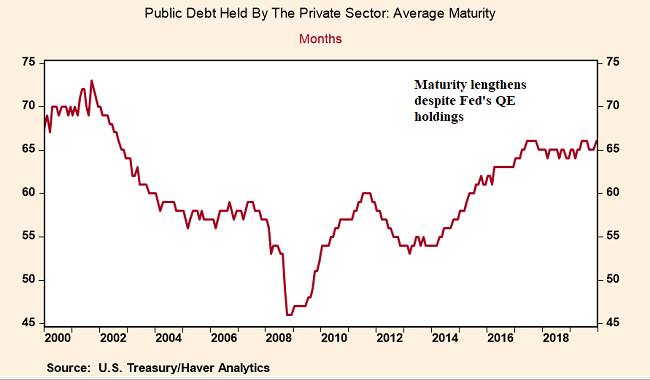
Gavin Davies shows the following graph, congratulating the Treasury for going longer after 2008.

But weighted average maturity is a terrible statistic, and substantially overstates the maturity. It weights only the maturity of the principal, ignoring the coupons. If the Treasury introduced perpetuities, the weighted average maturity would instantly be infinity, which is obvious nonsense. We know how to calculate better numbers -- start with duration, which includes the maturity of the coupons. The Treasury's antiquated accounting is an obstacle to reform.

Well, a rise in rates is  hardly likely, you say. Indeed in the same volume as my perpetuities proposal, Robin Greenwood, Sam Hanson, Joshua Rudolph, and Larry Summers advocated an even shorter maturity structure. The ARM is cheaper, and they ran some situations that a rise in interest rates was unlikely given the statistical patterns of recent history.

But past history does not always continue. I buy earthquake insurance in California even though there hasn't been a really big one since 1906. The same statistical approach to risk management blows up regularly. Economists working on climate change often make the insurance argument -- sure, the conditional mean is not a catastrophic impact, but we should take out insurance that it's not much worse than we think.

A debt crisis is like the Spanish Inquisition. Nobody expects it. Alan Blinder, for example, writing in WSJ echoes this conventional wisdom,

First, at least for now, the Fed is buying as many debt securities as the Treasury is selling. On net, the investing public doesn’t have to buy any.
Wait a minute, Alan, the public does have to hold the reserves, which are just another form of government debt!

Second, the U.S. borrows in its own currency. Sovereign debt crises almost never arise in such cases.
True, but inflations do. Riots, civil wars, pandemics and coups "almost" never arise either, yet we are well advised to pay some attention. And the US has had one big debt crisis in 1972, though we borrow in our own currency and under Bretton Woods the dollar was the reserve currency. Foreigners distrusted the dollar and demanded payment in gold, which we ran out of.  (Short version). The UK had several debt/currency/inflation crises.

Third, if the U.S. Treasury starts to supply more bonds than the world’s investors demand, the markets will warn us with higher interest rates and a sagging dollar. No such yellow lights are flashing.
Did I mention that nobody expects a run? Flashing yellow lights did not warn Greece, Lehman Bros., or the US.

Here are 10 year rates and inflation through the 1970s and 1980s. 10 year rates never saw inflation ahead of time. They didn't see the decline in inflation even after it happened.

Fourth, interest rates on government debt in several advanced countries—notably but not only Japan—are superlow today even though their national debts are far higher, relative to gross domestic product, than seemed prudent a decade or two ago.
So AIG was in worse shape than Lehman.

Fifth, the U.S. public debt topped 100% of GDP at the end of World War II with no adverse consequences. After that peak, we managed to whittle the debt down to only 22% of GDP over the next 28 years or so. To accomplish that feat, we didn’t need to run budget surpluses year after year. We just kept deficits small enough that the debt grew slower than GDP. Which is not that hard if the interest rate remains below the economy’s growth rate—as has been true for years.

Actually, post WWII, after a quick bout of inflation that wiped out some of the real value of debt, the US ran steady primary surpluses until 1975. And had strong supply-side growth in a much less regulated economy. Let's be nice -- "keep deficits small enough" is wisdom widely overlooked around Washington.

"if the if the interest rate remains below the economy’s growth rate—as has been true for years" sounds  a lot to me like "if the stock market keeps going up at 7% per year -- as has been true for years."

Yes, I was worried in 2008, and the crisis hasn't happened yet. But the logic of it does not suggest  a classic near-term forecast. It could wait 10 or 20 years. We could escape with strong supply side growth, and "deficits small enough" by sensible reforms. But if it came -- doubtless in a deep recession, social unrest, perhaps war, just the sort of times that people doubt America's ability to reform itself and pay off its debt -- it would be an immense disaster.

Locking in 1% interest rates for a generation seems like a no-brainer. While markets are willing to sell us insurance at this rate, take it.

Updates:

1) A colleague writes,

Might the short term debt issuance be a way the government is implicitly committing to not inflate the debt away. Such inflation would be much more painful than say deciding to inflate away debt with a long maturity structure?
This is a good point. The short maturity structure is much harder to inflate away. The long maturity structure means in the event of inflation, default, widening credit spreads for the US, etc., the government comes out ahead, and is thus less likely to avoid the event. Seeing the US in effect take a big bet on inflation might also scare markets a bit. It's sort of like showing up at the insurance office with a can of gasoline under one arm. Like swaps, it also raises the counterparty question. If the US issues 30 year bonds, interest rates rise, the bondholders take a huge hit. Will the US really allow that to happen? If the bondholders are big banks, pension funds, and so forth?

I think Merton Miller once suggested that Hong Kong defend a currency peg by writing a huge number of options against it, which would profit if the peg did not fall apart and ruin the country if it did.

2) In my memory of history, I can think of only one and a half times that debt to GDP greater than 100% has ended well for bondholders in the last 1000 years. The UK following the napoleonic wars is the first (funded by perpetuities, by the way). The US after WWII is the half - the inflation of 1945-46, the collapse of Bretton Woods and inflation of the early 1970s also contributed a bit. The UK following WWII was not a success. The UK grew out of the debt -- it started the industrial revolution. So both US and UK successes trace to a surge of supply-side growth, with sober fiscal management -- at least primary surpluses, as above.  We have neither going forward.  I asked some assembled economic historians for other examples. The US after the civil war came up. That's about it. I welcome other antecedents, especially ones with sclerotic growth and ever expanding deficits.

English

Anies Baswedan

Tekno